Beyond SEO: Mastering SXO and SGE for the Future of Search
In the age of Search Generative Experience (SGE) and intent-based search, SXO is no longer a “nice to have”, it’s a competitive necessity.
Search behaviour is evolving at a blistering pace. With Google SGE integrating Large Language Models (LLMs) into search experiences, the focus has shifted from mere visibility to contextual relevance, interaction quality, and holistic user experience.
At Matter Design & Digital, we’re at the forefront of this evolution, helping brands transition from SEO-centric to SXO- and SGE-aligned strategies that resonate with both users and machines.
Explore how LLMs are reshaping search:
-
Generative Engine Optimisation (GEO): Preparing Your Website for the Future of AI Search
- Future-Ready Content: Why Your Website Needs an llms.txt File
Key Takeaways
- SXO (Search Experience Optimisation) enhances both visibility (SEO) and post-click UX to increase conversions.
- It blends technical SEO, performance UX, and CRO, especially relevant in an AI-driven search landscape (SGE).
- Top improvements include better intent mapping, site speed, schema markup, and personalised experiences.
- SXO success metrics should span SEO, UX, conversion rates, and on-site search behaviour.
- SXO positions ecommerce brands to thrive in traditional SERPs and emerging AI-driven search experiences.
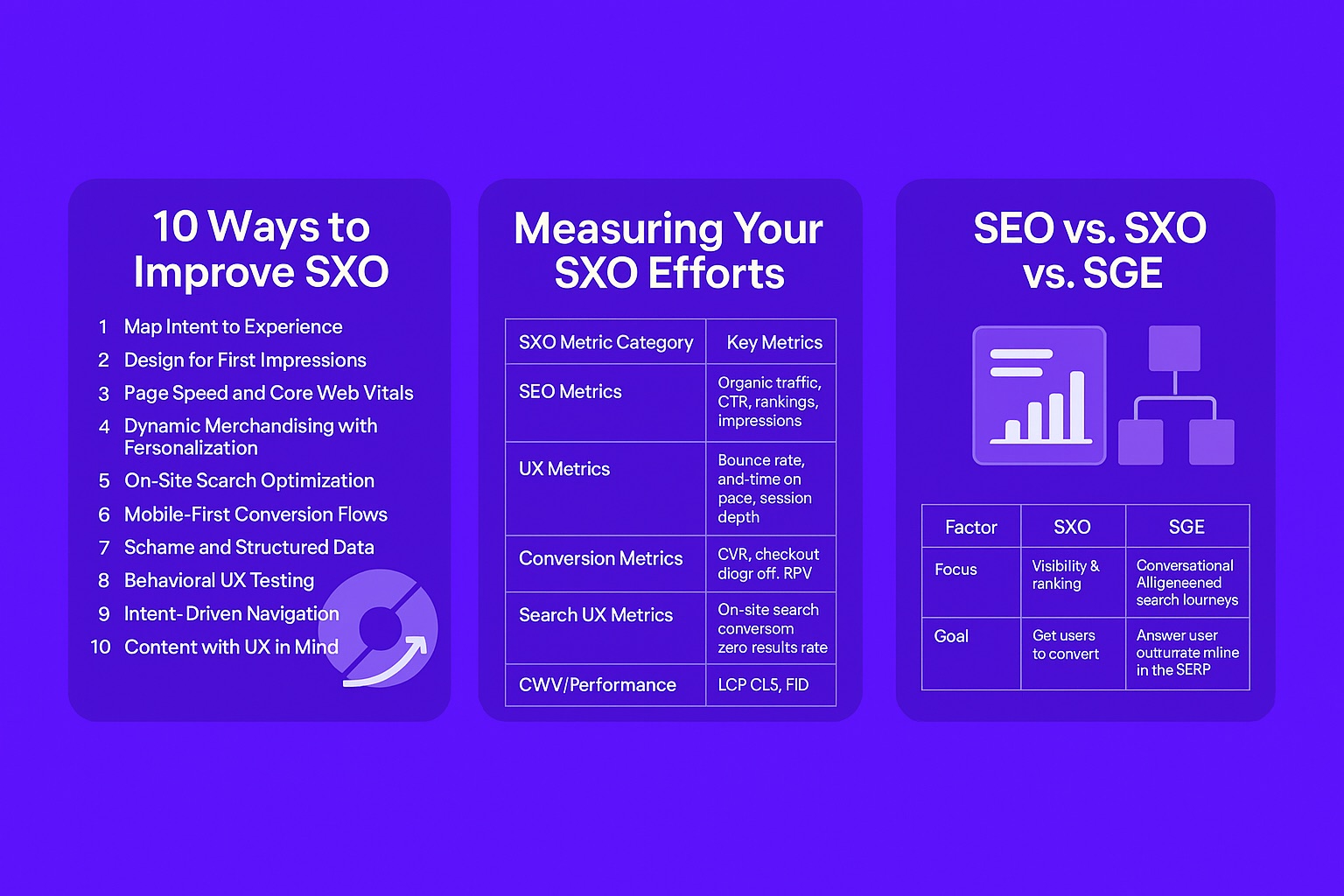
SEO vs. SXO vs. SGE
SEO: The Foundation
SEO focuses on optimising website elements to improve rankings on search engine results pages (SERPs). Key components include keyword research, on-page optimisation, backlink building, and technical enhancements like site speed and mobile responsiveness.
- Focus: Visibility & ranking
- Goal: Get users to the page
- Tactics: Keywords, links, metadata
- Impact on CX: Indirect
SXO: Enhancing the User Journey
SXO is the evolution of SEO, one that doesn’t stop at getting users to your site but focuses on what happens after the click. It's a user-centred approach that integrates SEO, UX design, technical performance, and conversion strategy to provide seamless, satisfying search experiences.
While SEO focuses on visibility and ranking, SXO ensures that when users click through to your site, they:
- Find what they’re looking for intuitively
- Receive value immediately
- Are guided toward high-conversion paths
- Focus: End-to-end user satisfaction
- Goal: Get users to convert
- Tactics: UX design, page speed, personalisation
- Impact on CX: Direct and measurable
SGE: The AI-Powered Frontier
GEO represents Google's integration of generative AI into search, providing users with synthesised, conversational responses directly within the search interface. This shift necessitates content that is not only optimised for keywords but also structured to be easily interpreted and presented by AI models.
- Focus: Conversational AI-generated search journeys
- Goal: Answer user questions inline in the SERP
- Tactics: Structured data, topical authority, content utility
- Impact on CX: Requires pre-emptive optimisation for AI agents
SXO bridges the gap between SEO and SGE. With Google increasingly offering direct answers, brands need SXO to differentiate the value of their owned experience.
10 Ways to Improve SXO
Here’s how ecommerce businesses can level up their SXO game:
- Map Intent to Experience
Understand search intent at every funnel stage. Create content and UX flows that match informational, navigational, and transactional intents. Use SEO tools like Ahrefs or SEMRush to align keyword clusters with specific landing experiences. - Design for First Impressions
Above-the-fold UX matters. Ensure your hero area clearly answers: “Am I in the right place?” This includes value props, trust signals, search filters, and CTAs. - Page Speed and Core Web Vitals
Users (and Google) punish slow-loading pages. Use Lighthouse and PageSpeed Insights to optimise for metrics like FID, LCP, and CLS. Deploy lazy loading and server-side rendering for e-commerce-heavy assets. - Dynamic Merchandising with Personalisation
Leverage session data and personalisation engines (e.g., Shopify’s Hydrogen + Remix stack) to dynamically tailor search landing pages based on user behaviour or geo signals. - On-Site Search Optimisation
Improve your internal site search UX. Implement autocomplete, predictive results, typo tolerance, and merchandising rules. Ensure analytics are set up to track zero-result queries. - Mobile-First Conversion Flows
Most search-driven traffic is mobile. Build frictionless mobile journeys: thumb-friendly buttons, collapsed filters, sticky CTAs, and seamless checkout experiences. - Schema and Structured Data
Use schema markup for products, reviews, FAQs, and breadcrumbs. These enhance rich snippets and support visibility in SGE and traditional SERPs. - Behavioural UX Testing
Run A/B tests on landing pages derived from organic traffic. Tools like Hotjar or Microsoft Clarity help uncover friction points and test new variations. - Intent-Driven Navigation
Menu structures, category pages, and filters should reflect search behaviour. Use search data to adjust taxonomies based on top queries and exit paths. - Content with UX in Mind
Avoid content for content’s sake. Write category descriptions, guides, and blog content with readability, skim-ability, and helpful CTAs, especially above the fold.
Measuring Your SXO Efforts
Because SXO spans visibility and engagement, metrics need to reflect both:
- SXO Metric Category: SEO Metrics
Key Metrics: Organic traffic, CTR, rankings, impressions
Tools: Google Search Console - SXO Metric Category: UX Metrics
Key Metrics: Bounce rate, avg. time on page, session depth
Tools: Google Analytics 4, Hotjar - SXO Metric Category: Conversion Metrics
Key Metrics: CVR, checkout drop-off, RPV
Tools: BigCommerce, Shopify, Google Analytics 4 - SXO Metric Category: Search UX Metrics
Key Metrics: On-site search conversion, zero-results rate
Tools: Search data from your search platform, BigCommerce/Shopify Search - SXO Metric Category: CWV/Performance
Key Metrics: LCP, CLS, FID
Tools: PageSpeed Insights
Set benchmarks per page type (homepage, category, product, blog) and track monthly deltas to identify friction or success zones.
Final Thoughts
SXO isn’t just a technical adjustment; it’s a mindset shift. E-commerce brands that master it will gain compound advantages: better organic visibility, lower bounce rates, and higher lifetime value.
At Matter, we approach SXO as a strategic lever across the full digital funnel, from how users find your store to how they move through it. If you’re ready to elevate your e-commerce CX through search, reach out. Let’s turn intent into impact.