AEO Readiness in 2026: How Answer Engine Optimisation Is Redefining Ecommerce Search
SEO has always been about earning space in a ranked list. AEO (Answer Engine Optimisation) is about being selected as the answer.
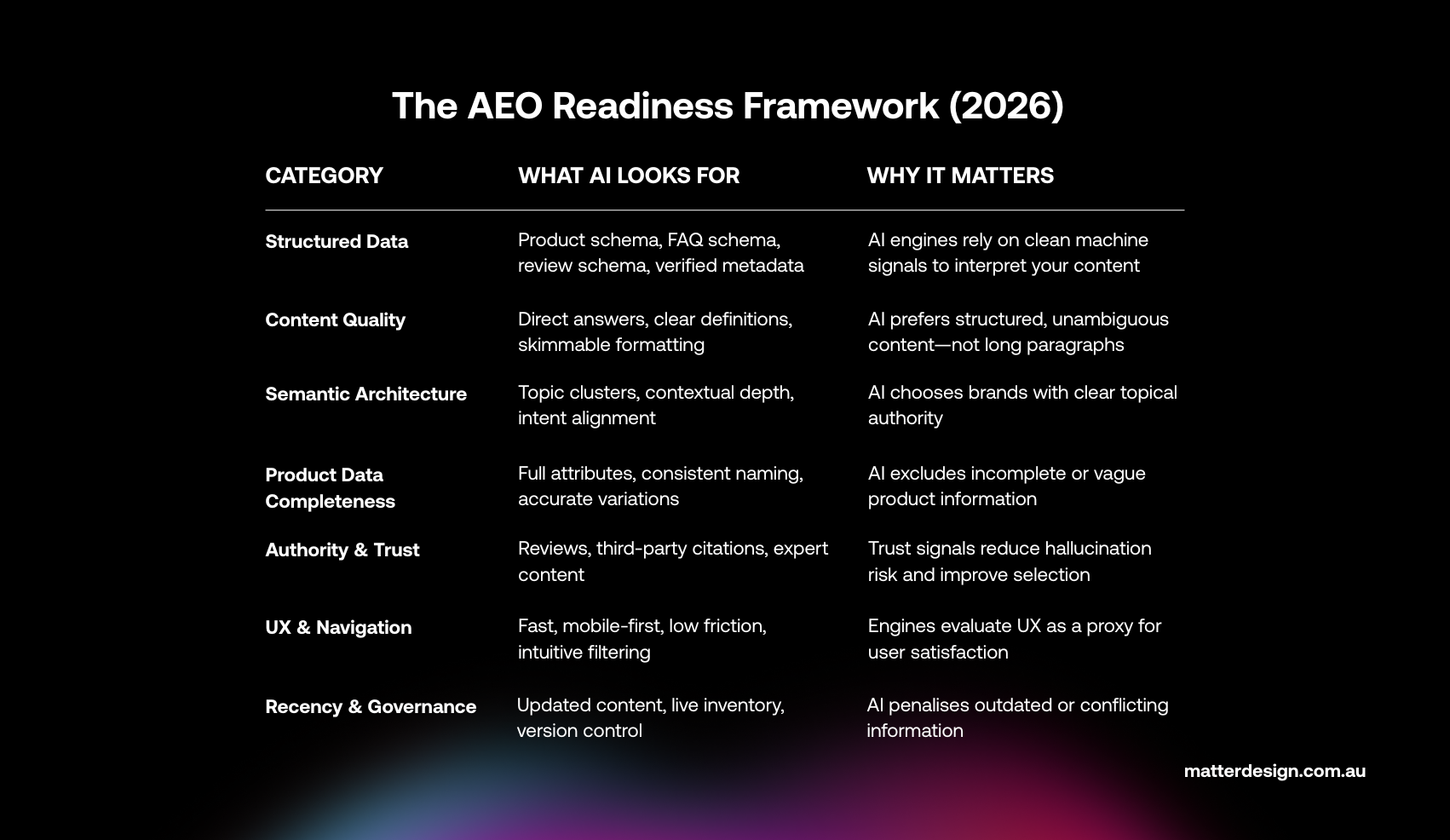
Answer Engine Optimisation (AEO) is the practice of structuring ecommerce content so AI systems like ChatGPT, Perplexity, Google AI Overviews, and Gemini can extract, verify, and present your information as direct answers to user queries.
Unlike traditional SEO, which focuses on ranking in search results lists, AEO focuses on being selected as the single answer AI engines provide to users. More than 60% of searches now end without a click to any website. Gartner predicts that by 2026, search engine volume will drop 25% due to AI chatbots and answer engines.
If your e-commerce brand isn't optimised for answer engines, you simply don’t exist during the most critical phase of customer discovery. The brands winning visibility aren’t the ones with the most keywords or backlinks; they’re the ones whose content AI systems can interpret, verify, and trust.
Explore how LLMs are reshaping search:
-
Generative Engine Optimisation (GEO): Preparing Your Website for the Future of AI Search
- Future-Ready Content: Why Your Website Needs an llms.txt File
Quick Answers: Understanding AEO
Q: What is AEO?
Answer Engine Optimisation (AEO) is the process of structuring content so AI systems can easily extract and cite it as authoritative answers to user queries.
Q: How is AEO different from SEO?
SEO helps you rank in traditional search results. AEO ensures AI engines select your content as the definitive answer. Both are essential for modern e-commerce visibility.
Q: Do e-commerce brands need AEO in 2026?
Yes. With 60% of searches ending without clicks, AEO determines whether your brand appears in AI-generated answers during the discovery phase when customers are actively researching products.
Q: How long does AEO implementation take?
Most ecommerce brands can implement basic AEO principles within 4-8 weeks. Full optimisation across large product catalogues typically takes 3-6 months.
Q: What's the ROI of AEO for e-commerce?
E-commerce brands with strong AEO see 30-50% increases in brand mentions across AI platforms within 6 months, leading to higher brand awareness and qualified traffic.
AEO: The New Baseline for Digital Visibility
In an AI-led search landscape, there is no page two. There is no list of ten links. There is at most one summary, one product set, and one recommendation.
AI systems choose the clearest, most structured, most trustworthy information. If your content doesn’t meet that threshold, you’re filtered out no matter how strong your SEO foundations are.
AEO is not an SEO add-on. It’s a strategic capability for any brand that wants visibility in a world where zero-click search is the dominant user behaviour.
Why Is AEO Important in 2026?
Three major shifts have accelerated AEO from “interesting trend” to “critical priority”:
1. Zero-click search is standard
According to SparkToro's 2024 Zero-Click Search Study, approximately 60% of Google searches end without a click to an external website. AI engines summarise the answer themselves and move on.
2. AI engines show fewer sources
Research from GEO Summit 2024 shows AI engines cite 2-3 sources on average, down from 10+ traditional search results. Authority and clarity matter more than ever.
3. AI hallucinations make weak brands risky to surface
If your data is inconsistent or incomplete, AI models are more likely to hallucinate about your brand, so engines avoid citing you altogether.
AEO mitigates this risk by providing AI systems with consistent, verifiable, and machine-readable information.
Why Sydney E-commerce Brands Need AEO Now
Sydney-based e-commerce businesses competing in Australian and international markets face a critical decision point. AI-driven search is fundamentally changing how consumers discover products, and the window for early adoption advantage is narrowing.
The Sydney advantage: Most Australian retailers are still focused exclusively on traditional SEO. Sydney ecommerce brands that implement AEO now will establish authority in AI systems before competitors recognise the shift.
High-pressure categories for Sydney brands:
- Fashion & apparel: Where consumers heavily use AI for style recommendations and product comparisons
- Homewares & furniture: Where AI engines provide spatial and aesthetic guidance
- Beauty & skincare: Where ingredient queries and suitability questions dominate AI searches
- Specialty foods: Where provenance, ingredients, and dietary compatibility drive AI recommendations
Local competition factor: International e-commerce brands are already optimising for AI engines. Sydney businesses that delay AEO adoption risk losing visibility not just to local competitors, but to global brands capturing Australian consumer queries in ChatGPT, Perplexity, and Google AI Overviews.
For Sydney brands selling nationally or internationally, AEO isn't just about keeping pace; it's about establishing Australian expertise and authority that AI systems recognise and prefer when answering Australia-specific queries.
How Do AI Search Engines Decide What Content to Include?
AI engines don’t “index” the web. They evaluate and assemble meaning. Across ChatGPT, Gemini, Perplexity and SGE, six signals consistently shape visibility:
- Clarity: Does the content provide a direct answer?
- Structure: Can the model easily extract it?
- Authority: Is the source trusted across the web?
- Recency: Is the information up to date?
- Data completeness: Are product attributes and metadata consistent?
- Entity-level alignment: Do your brand signals match across platforms?
This is why many high-ranking SEO pages still do not appear in AI-generated summaries. They’re written for humans, not machines. AEO closes that gap.
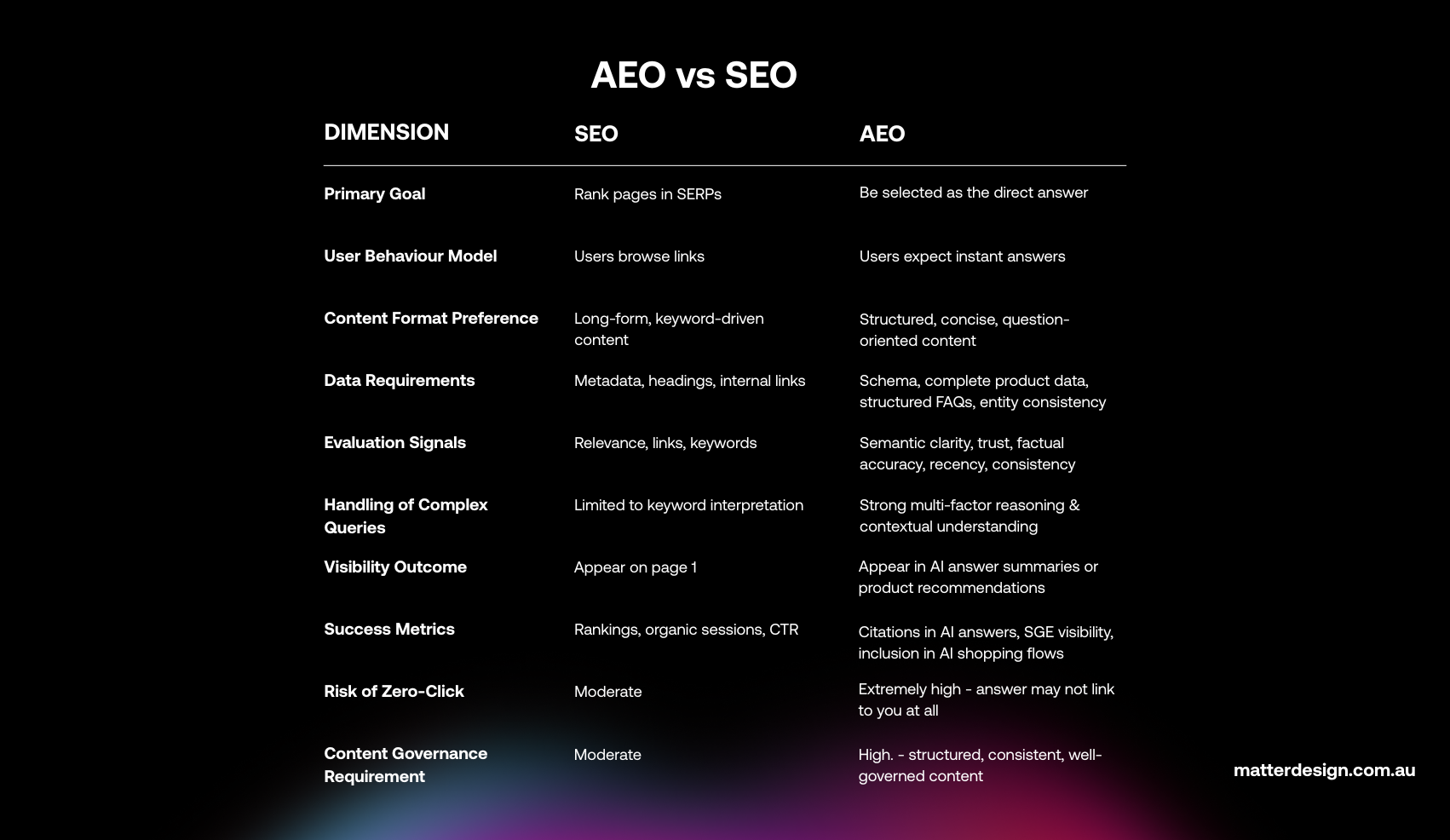
How Does AEO Differ from SEO?
Here is the most straightforward way to understand the relationship:
- SEO = discoverability
- AEO = eligibility
- GEO (Generative Engine Optimisation) = citation
SEO gets you indexed.
AEO gets you selected.
GEO gets you referenced.
You need all three, but for e-commerce, AEO now determines whether AI will even consider your content at the point of decision-making.
How Can E-commerce Brands Implement AEO? [6-Step Framework]
Below is a consolidated version of the framework we created, designed specifically for e-commerce leaders:
What Are the Essential AEO Actions for E-commerce Brands?
Here are the clearest, most effective actions ecommerce leaders can take today to protect visibility:
1. Rewrite key pages using a direct Q&A structure
If your content doesn’t look like an answer, AI won’t treat it as one.
This means:
- clear question headers
- concise 2–4 sentence answers
- definitions and summaries
- FAQ schema
This immediately increases eligibility in AI responses.
2. Fix your product data governance
AI engines avoid recommending products with inconsistent or messy data.
Standardise:
- product titles
- attributes
- materials/ingredients
- care instructions
- benefit statements
- naming conventions
This is especially critical for brands with large catalogues.
3. Strengthen your entity footprint across the web
AI systems cross-reference the following data points, which Australian ecommerce brands should ensure NAP data consistency:
- Google Business Profile
- Apple Maps
- Bing Places
- Australian business directories (True Local, Yellow Pages Australia)
- Industry-specific Australian platforms
Inconsistent NAP data (Name, Address, Phone) will disqualify you from many AI surfaces.
4. Build topical authority, not just content volume
In answer engines, depth > breadth.
Develop:
- interlinked topic clusters
- category-level educational content
- problem/solution frameworks
- expert-led guides
Authority compounds.
5. Implement schema properly, everywhere
FAQ schema, Product schema, Review schema, Article schema. This is not optional anymore.
Schema is how AI systems verify what you say.
6. Monitor your brand in AI engines quarterly
Track:
- where you appear
- which products surface
- hallucinations
- missing categories
- new opportunities
AEO is now a permanent operational discipline, not a one-off optimisation.
Final Perspective: AEO Is Not Marketing, It’s Infrastructure
In 2026, answer engines function as a distribution layer, not just an interface. They mediate customer discovery, guide purchase decisions, and filter product options. For e-commerce brands, this creates a critical visibility threshold. Brands optimised for AI systems enjoy disproportionate visibility. Brands that delay AEO implementation face increasingly difficult barriers to entry as AI systems favour established, trusted entities.
For e-commerce brands, this means:
- AEO is not content tuning
- AEO is not a future trend
- AEO is not optional
AEO is infrastructure, part of the cost of being visible in an AI-led digital economy. Brands that invest early will enjoy disproportionate visibility. Brands that delay will face an uphill battle to re-enter AI ecosystems that increasingly prefer trusted, established entities.
The question for e-commerce leaders is no longer:
“Should we invest in AEO?”
It’s:
“How quickly can we build AI-ready content and data pipelines before our visibility erodes?”
The brands that win the next era of e-commerce are the ones that make themselves answerable.
Getting Started with AEO: Sydney Ecommerce Support
Ready to make your e-commerce brand visible in AI search? AEO is no longer optional for e-commerce brands that want to maintain visibility as search behaviour shifts to AI engines. Our Sydney-based team specialises in preparing e-commerce businesses for answer engine optimisation.
What we offer:
- AEO readiness audits for e-commerce catalogues
- Product data optimisation and schema implementation
- Content restructuring for AI extraction
- Entity building and authority development
- Ongoing AI engine monitoring and optimisation
Book a free 30-minute consultation to discuss your brand's AEO strategy and get actionable recommendations for your product catalogue.