Decoupling the ERP: Rethinking the Centre of Your Commerce Stack
For years, the ERP has been seen as the single source of truth for all data and operations. In today's digital-first commerce, this model is outdated and holds businesses back. It's time to decouple.
The ERP Bottleneck
Let’s start with the problem.
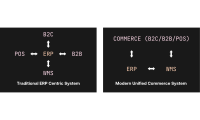
ERP systems are great at what they were designed for: handling financials, procurement, supply chain, inventory control, and reporting. But when businesses try to use ERP as the hub for every customer-facing process — product content, pricing, promotions, omnichannel inventory — it creates bottlenecks.
In ERP-led commerce models, launching a new product or promotion often requires:
- Aligning with IT teams to update data structures.
- Waiting for integration cycles to sync with eCommerce platforms.
- Managing delays from internal approval processes or vendor support.
That might have worked a decade ago. But today, brands need to move in real time, not on ERP timelines.
What Does Decoupling Mean?
Decoupling doesn’t mean removing your ERP. It means rethinking its role in your tech stack — letting it do what it does best, while giving commerce operations the autonomy to move faster and innovate.
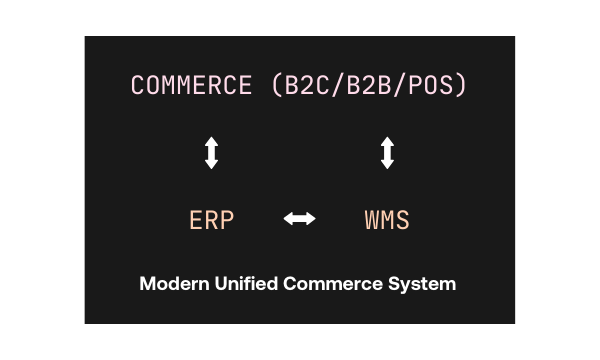
Instead of forcing every sales channel to connect directly to the ERP, businesses are now building commerce-first architectures. In these models:
- Commerce platforms like Shopify or BigCommerce are responsible for sales channels (B2C, B2B, marketplaces).
- POS systems like Shopify POS or Lightspeed are used for in-store retail.
- A Commerce Data Platform or Digital Commerce Manager (DCM) (like Qooly.io) becomes the central source for real-time product, inventory, pricing, and customer data.
- The ERP is reserved for financials, supplier management, and reporting.
Why Decouple? Key Benefits
1. Faster Time to Market
When digital teams aren’t waiting on ERP workflows, products go live faster, campaigns launch more smoothly, and promotions can be managed in real time. Teams can react to market trends, test pricing, and iterate without IT bottlenecks.
2. Cleaner Architecture
In a decoupled model, each platform is responsible for the part of the experience it’s best suited to manage. Data flows are cleaner, integrations are lighter, and the system becomes more scalable and future-proof.
3. Improved Customer Experience
By managing customer-facing data in a commerce-first system, you ensure that your product information, availability, and pricing are always accurate across every channel — website, mobile, in-store, and marketplaces.
4. Reduced Costs and Risk
Decoupling removes the need for deep custom ERP integrations. That means fewer development hours, lower integration costs, and reduced risk when upgrading platforms or adding new sales channels.
Decoupling in Practice: Two Platform Approaches
Shopify
Shopify merchants often manage both B2C and B2B sales through a single storefront experience. With Shopify POS, in-store sales and inventory are already natively integrated. In some cases, Shopify itself acts as the Digital Commerce Manager, especially for leaner organisations or those who want fewer platforms in the mix.
But when more complex data orchestration is required, a platform like Qooly can act as the DCM — managing data from the ERP, enriching product content, and feeding it into Shopify across different channels.
BigCommerce
For merchants running BigCommerce, the architecture may also include Lightspeed POS for in-store operations. In this setup, BigCommerce manages digital commerce, Lightspeed handles in-store transactions, and a DCM (again, like Qooly) ensures unified data across both. The ERP still handles backend operations, but commerce flows independently of it.
This modular architecture makes it easier to scale globally, launch into marketplaces, or enable complex B2B pricing models — all without constantly rebuilding ERP integrations.
Common Decoupling Scenarios
Wondering if this model applies to you? Here are some common triggers for ERP decoupling:
- Your ERP is slowing down eCommerce deployments or promotions.
- Your business is growing into B2B and D2C simultaneously.
- You want to enable real-time inventory visibility across stores, warehouses, and 3PLs.
- Your teams are spending too much time on manual data updates or sync failures.
- You want to experiment with new channels — like marketplaces or international stores — without massive IT overhead.
What Stays in the ERP?
Let’s be clear: we’re not anti-ERP. In fact, a well-managed ERP remains essential for business stability. But in a decoupled model, it focuses on:
- Financial transactions and accounting
- Supplier and procurement data
- Compliance and reporting
- Master data that doesn’t change in real time
Meanwhile, the systems built for speed, agility, and customer experience — your commerce platforms and DCM — manage the rest.
Final Thoughts: It’s Time to Rethink the Centre of Your Stack
The idea that ERP should be the centre of your digital ecosystem is a legacy from a different era. Today, the centre of your architecture should be your customers — and the platforms that serve them best.
Whether you’re scaling into new markets, embracing B2B, or simply trying to reduce IT friction, decoupling your ERP is a strategic move. It empowers your teams, improves performance, and creates the foundation for unified, omnichannel success.
Want to Learn More? Download Our Full Framework
We’ve created a detailed PDF outlining the idea of decoupling the ERP and how reducing ERP reliance can accelerate B2B & B2C eCommerce projects.