Why 2026 Will Be the Year of Hybrid-Headless (And How Shopify Hydrogen 3.0 Changed the Game)
Hybrid-headless is about choosing an architecture that lets you scale performance, AI capability, and operational velocity without multiplying complexity.
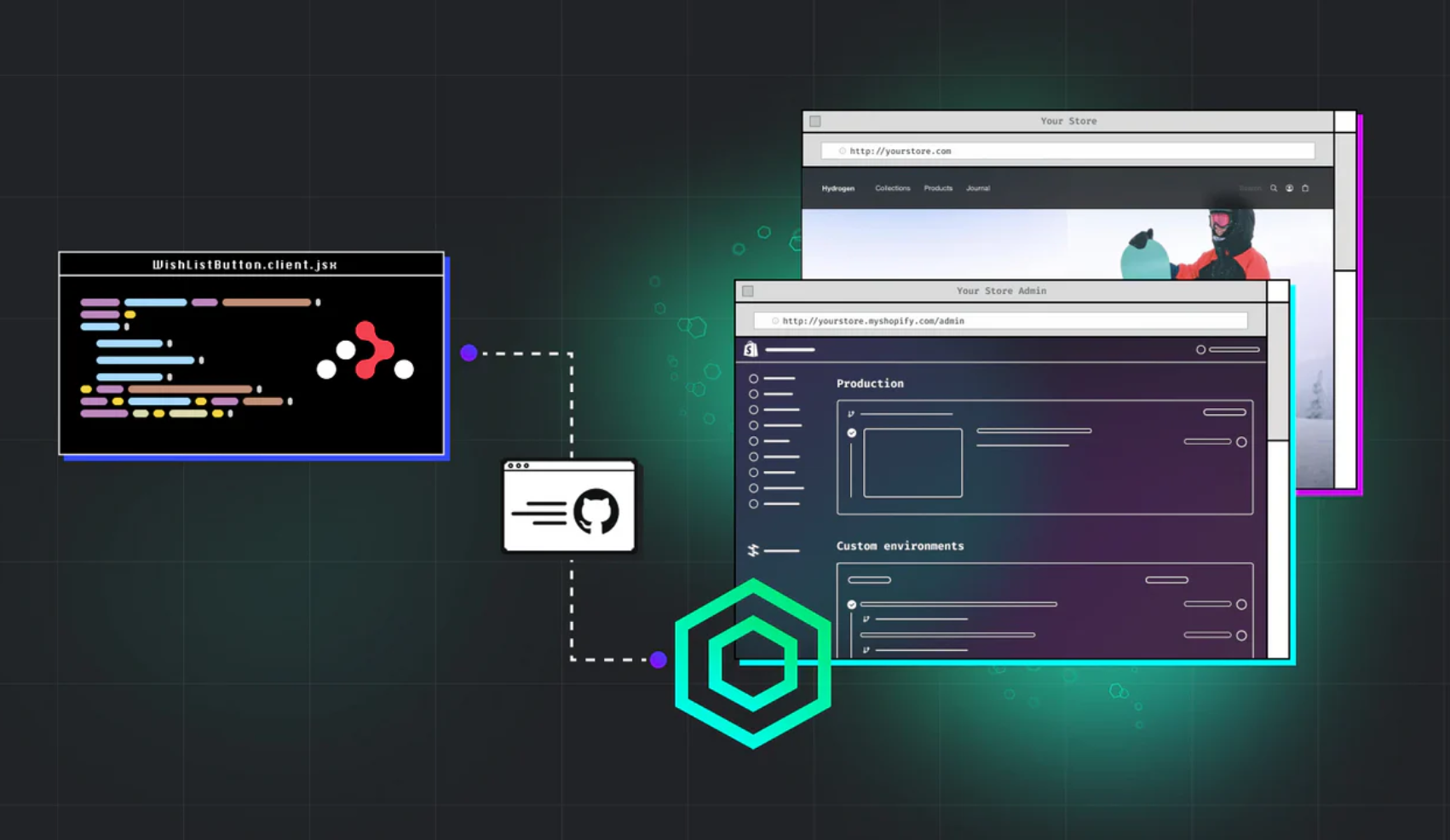
By 2026, hybrid-headless commerce will replace both traditional monoliths and “pure” headless builds as the default architecture for scaling ecommerce brands. It’s the only approach that consistently balances:
- Performance (Core Web Vitals, edge delivery, smaller JS payloads)
- AI readiness (native commerce context + automation-friendly APIs)
- Operational stability (single source of truth for pricing/checkout/inventory)
- Total cost of ownership (TCO) (less duplicated logic + less DevOps burden)
Shopify Hydrogen 3.0 accelerates this shift by making modern headless practical: it enables server-component-driven storefronts while keeping the commerce engine authoritative, preserving checkout integrity, platform guarantees, and merchant-grade operability.
Quick Answers: Understanding Hybrid-Headless in 2026
Q: What is hybrid-headless commerce?
Hybrid-headless is an architecture where the experience layer is decoupled (headless), but the transactional commerce core stays platform-native, including pricing, inventory, promotions, customer context, and checkout.
Q: How is hybrid-headless different from pure headless?
Pure headless fully decouples systems and often forces teams to rebuild or duplicate commerce logic across layers. Hybrid-headless decouples only where it creates business value, preserving native commerce authority and reducing operational risk.
Q: Why does hybrid-headless matter in 2026 specifically?
Because 2026 is when AI-driven commerce workflows, strict performance expectations, and TCO pressure converge. Hybrid-headless is the only model that consistently supports all three without architectural sprawl.
Q: What did Shopify Hydrogen 3.0 change?
Hydrogen 3.0 makes headless more sustainable by pairing React Server Components + Shopify-native commerce primitives and enabling edge deployment via Oxygen, reducing frontend bloat and infrastructure overhead.
Q: Is hybrid-headless right for every brand?
No. It’s a scaling architecture, best for brands with performance sensitivity, complex merchandising, multi-market growth, or AI personalisation roadmaps. It’s often unnecessary for MVPs and simple catalogue stores.
Hybrid-Headless: The New Baseline for Scalable Commerce
In 2026, architecture isn’t a “tech preference”. It’s a competitive constraint. The brands that win aren’t necessarily building the most custom stacks; they’re building stacks that let them ship faster, personalise deeper, and operate reliably while traffic, channels, and complexity grow.
Hybrid-headless works because it treats e-commerce for what it is: a system where transactional integrity matters as much as experience innovation. It avoids the failure mode of many headless programs: beautiful frontends that become expensive to maintain because the commerce brain got fragmented.
What hybrid-headless optimises for
- Experience differentiation where it matters (high-value journeys, brand moments, complex flows)
- Commerce certainty everywhere (platform-native pricing/promos/checkout rules)
- Operational velocity (merchant teams can operate without engineering bottlenecks)
- Reliability under load (platform guarantees + fewer integration points to break)
What Is Hybrid-Headless Commerce?
Hybrid-headless commerce is an architecture where the experience layer is decoupled, but the commerce engine remains platform-native.
A simple way to think about it: the storefront becomes flexible, but the commerce rules remain consistent.
In simple terms
- Frontend experience is custom and decoupled (headless)
- Backend commerce core remains platform-native (Shopify, BigCommerce, etc.)
- Transactional integrity is preserved through native checkout, pricing, and inventory
This differs from pure headless by keeping critical commerce logic centralised while enabling frontend flexibility.
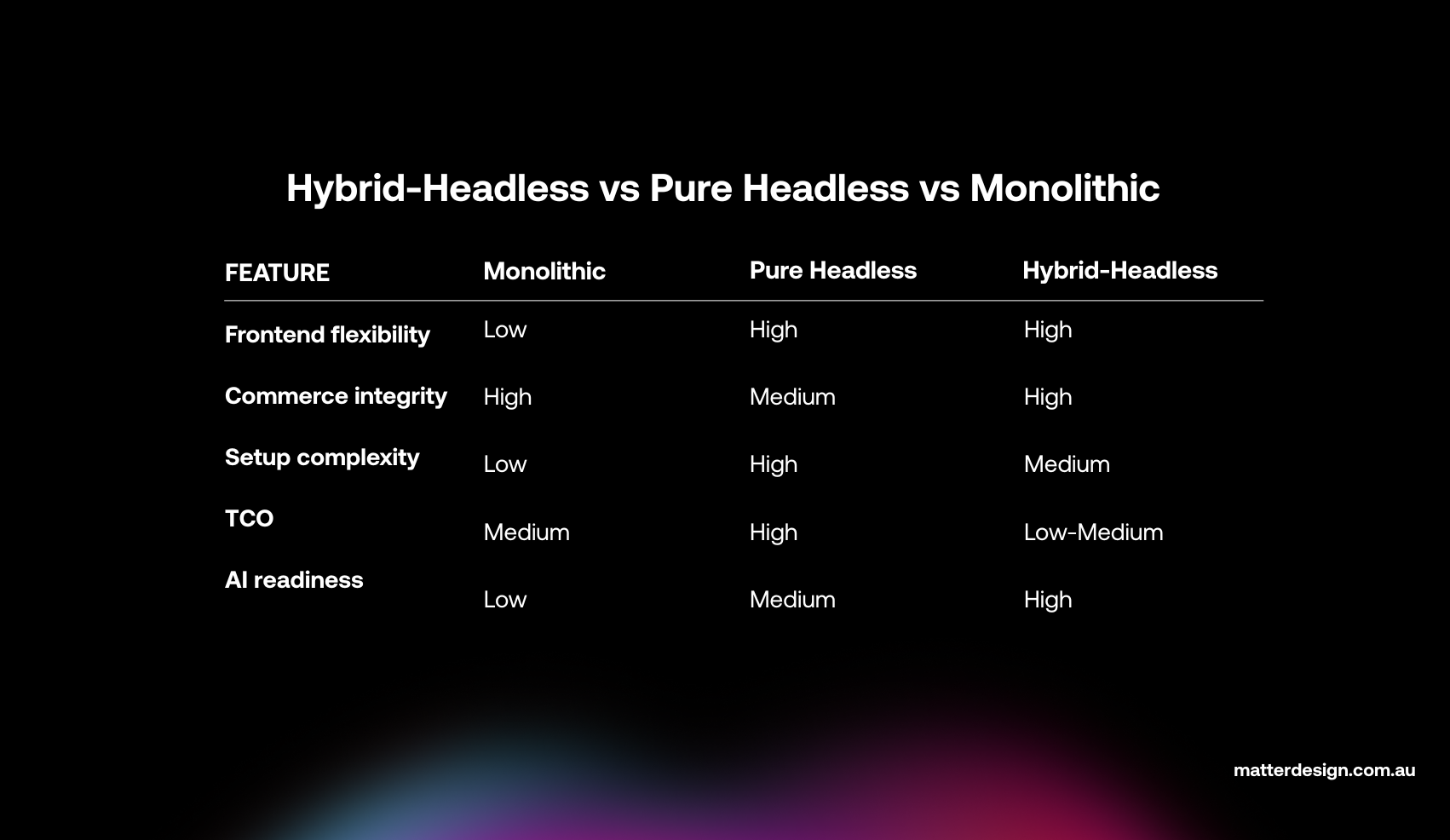
Hybrid-headless keeps (commerce integrity)
Hybrid-headless preserves a single authoritative system for:
- Pricing and promotion logic (no drift across channels)
-
Inventory availability and fulfilment constraints
- Checkout guarantees (tax, payments, compliance, fraud controls)
- Merchant-grade operational tooling (day-to-day changes don’t require redeploys)
Hybrid-headless enables (experience performance)
Hybrid-headless unlocks:
- High-performance storefronts tuned for Core Web Vitals
- Edge rendering and caching strategies that scale
- Selective composability (best-of-breed where justified)
-
Faster iteration without operational risk
Hybrid-headless architectures are increasingly referenced in broader discussions around composable and pragmatic commerce stacks, including guidance from organisations such as the MACH Alliance, which highlights selective composability over full decoupling.
Key principle:
Decouple the experience, not the engine.
How Is Hybrid-Headless Different From Pure Headless?
Pure headless fully decouples frontend and backend systems. That sounds clean, until commerce reality hits: promotions, pricing, carts, customer identity, and checkout rules don’t like being split across multiple “sources of truth.”
Hybrid-headless is a more pragmatic line in the sand: decouple only what drives differentiation, keep what must remain consistent.
What pure headless typically introduces (hidden complexity)
Pure headless often creates systemic issues such as:
- Duplicated pricing and promotion logic across middleware, frontend, and CMS
- Fragmented cart and session state (harder debugging, more edge cases)
- DevOps and infrastructure overhead (hosting, caching, observability, security)
- Slower iteration for non-technical teams (everything becomes a code change)
- Higher long-term maintenance cost (integration sprawl + constant patching)
How hybrid-headless avoids these issues (architecture by responsibility)
Hybrid-headless reduces failure modes by:
- Keeping checkout, pricing, and inventory authoritative inside the platform
- Sharing state and business rules rather than duplicating them
- Reducing system orchestration complexity
- Preserving platform guarantees while still enabling custom UX
Result:
Hybrid-headless delivers most of headless’s upside **without destabilising commerce operations.
Why Is 2026 the Inflection Point for Hybrid-Headless?
Hybrid-headless has existed conceptually for years. In 2026, it becomes the default because three forces converge and make it structurally necessary, not just “nice to have.”
1) Why does AI require a hybrid-headless architecture?
AI-driven commerce systems need native platform context to be accurate, safe, and effective. As AI moves beyond surface-level features, it begins to influence and automate decisions that are tightly coupled to the commerce engine.
By 2026, AI will no longer be limited to search, chatbots, or product recommendations. It increasingly controls:
-
Dynamic pricing and offer strategy
- Merchandising decisions (sorting, bundling, content generation)
- Checkout personalisation (payment options, friction reduction, incentives)
-
Demand forecasting and replenishment
- Inventory optimisation (allocation, backorder logic, fulfilment routing)
- Promotion orchestration (eligibility, stacking rules, guardrails)
Research from McKinsey highlights how generative AI is moving into core operational workflows, particularly in retail and commerce. These capabilities require:
- Accurate pricing rules
- Real-time inventory and availability
- Customer identity resolution
- Fulfilment constraints
- Checkout validation and compliance guarantees
Pure headless forces AI to operate outside the commerce engine (more glue, more drift). Hybrid-headless allows AI to operate inside the engine (more truth, less risk).
This is why platforms like Shopify and Adobe are embedding AI directly into their commerce ecosystems rather than treating it as a bolt-on feature.
2) Why do performance requirements favour hybrid-headless?
Performance budgets are no longer aspirational; they’re competitive and commercial. In 2026, many brands treat performance as a revenue lever because speed impacts conversion, retention, and paid media efficiency.
Google outlines these requirements clearly across metrics such as LCP, INP, and CLS:
- Fast LCP
- Minimal client-side JavaScript
- Responsive interactions (low latency)
- Stable rendering (low layout shift)
Pure headless storefronts often struggle because they accumulate:
- Over-hydration (too much JS shipped to the client)
- Client-heavy rendering (slower time-to-interactive)
- Excessive middleware logic (latency + complexity)
- Fragmented caching strategies (hard to tune globally)
Hybrid-headless solves this by combining:
- Server-side rendering where it matters
- Edge execution for global performance
-
Platform-level caching primitives
- Server components to reduce JS payloads
Outcome:
Performance at scale **without frontend or infrastructure sprawl.
3) Why does cost pressure push teams toward hybrid-headless?
By 2026, architecture decisions will be evaluated on TCO. Many organisations have learned the hard way that “best-in-class everything” can become “most expensive to maintain.”
Common cost drivers in pure headless include:
- Duplicated CMS + commerce tooling
- High DevOps overhead and security maintenance
- Long development cycles for everyday changes
- Fragile integrations and ongoing vendor churn
- Expensive long-term maintenance and regression risk
Hybrid-headless reduces TCO by:
- Reusing native platform capabilities
- Minimising custom infrastructure
- Reducing duplicated logic (less drift, less QA)
- Simplifying ongoing operations and support
This shift toward pragmatic architectures is also reflected in industry frameworks such as the Thoughtworks Technology Radar, which increasingly emphasises sustainability and operability over novelty.
How Did Shopify Hydrogen 3.0 Change Headless Commerce?
Hydrogen 3.0 reframed Shopify headless from “build everything yourself” to a model where you can build a world-class custom storefront while keeping Shopify’s commerce brain intact.
This matters because the hardest part of e-commerce isn’t rendering UI. It’s maintaining correct behaviour under real-world complexity: discounts, taxes, inventory, fulfilment, customer identity, and checkout guarantees.
What is Shopify Hydrogen 3.0?
Hydrogen 3.0 is Shopify’s React-based framework for building high-performance custom storefronts that remain tightly integrated with Shopify’s commerce core.
Why it’s different:
It makes headless more sustainable by aligning frontend freedom with platform-native truth.
How do React Server Components improve performance?
Hydrogen 3.0 uses React Server Components (RSC) by default, which shifts more work to the server and reduces what needs to be hydrated in the browser.
This allows:
- Server-side data fetching
- Smaller JavaScript bundles
- Reduced client hydration
- Faster initial load times
- More predictable performance under scale
Why this matters:
It addresses a classic headless failure mode, frontend bloat that quietly erodes performance over time.
How does Hydrogen preserve commerce integrity?
Hydrogen does not ask you to rebuild commerce primitives. It consumes Shopify’s native capabilities directly, keeping the authoritative engine intact.
It directly uses:
- Shopify Storefront API
- Cart API
- Customer Accounts
- Shopify Functions
- Native checkout
This ensures:
- Pricing consistency
- Promotion accuracy
- Checkout reliability
- Compliance and security alignment
- Compatibility with future platform AI capabilities
What is Shopify Oxygen and why does it matter?
Oxygen is Shopify’s edge hosting platform for Hydrogen storefronts. It exists to remove a hidden tax of headless: infrastructure ownership.
Oxygen provides:
- Global edge deployment
- Built-in caching
- Automatic scaling
- Security hardening
- Reduced DevOps management
Impact:
Teams can ship edge-grade storefronts without becoming infrastructure operators.
Why is Hydrogen 3.0 truly “hybrid”?
Hydrogen supports incremental adoption, the practical requirement most brands have, but many headless programs ignore.
Brands can:
- Keep the Shopify Online Store for standard flows
- Use Hydrogen only for high-impact journeys
- Run hybrid storefronts side-by-side
- Migrate progressively over time
This lowers:
- Migration risk
- Upfront cost
- Organisational friction
- “Big bang rebuild” failure probability
What Does a Hybrid-Headless Shopify Architecture Look Like in 2026?
A mature hybrid-headless Shopify stack typically includes these layers, each with a clear responsibility boundary.
Experience layer (differentiation)
- Hydrogen (React Server Components)
- Edge rendering via Oxygen
- Partial hydration where interactivity is needed
Commerce core (authority)
- Shopify Checkout
- Native pricing and promotions
- Inventory and fulfilment logic
- Shopify Functions for extensibility
Content & merchandising (hybrid control)
- Shopify's native CMS for speed of change
- Optional headless CMS for editorial scale
- AI-assisted content generation workflows
Data & intelligence (optimisation)
- Shopify analytics
- CDP integration, where needed
- AI personalisation + experimentation layers
Governance & operations (stability)
- Platform permissions and access controls
- Versioned deployments
- Observability and audit trails
Who Should Use Hybrid-Headless Commerce?
Hybrid-headless is a scaling architecture, best introduced when there’s a clear reason: performance, complexity, global expansion, or an AI personalisation roadmap.
Best suited for
- High-traffic DTC brands
- Multi-market and multi-currency commerce
- B2B platforms with complex pricing and customer-specific catalogues
- Performance-critical experiences
- AI-driven personalisation strategies
Less suitable for
- Early-stage MVPs
- Simple catalogue sites
- Teams without frontend engineering capability
- Organisations that need operational simplicity over differentiation
Final Perspective: Why Hybrid-Headless Wins in 2026
By 2026:
- Monolithic platforms feel restrictive
- Pure headless feels over-engineered
- Hybrid-headless feels inevitable
Shopify Hydrogen 3.0 didn’t just “improve headless.” It formalised hybrid-headless as the most practical, scalable, and AI-ready architecture for modern ecommerce.
The brands that win in 2026 won’t be the ones with the most tools. They’ll be the ones with the cleanest architectural boundaries, where experiences can evolve fast, and commerce truth stays consistent.
Getting Started: Hybrid-Headless Readiness for Shopify Brands
If you’re planning a rebuild, performance uplift, or AI personalisation roadmap, the fastest path is to assess whether hybrid-headless is the right architectural step and where decoupling creates actual ROI.
What we typically help teams do:
- Hybrid-headless readiness audit (performance, complexity, team capability)
- Architecture blueprint (Hydrogen + Shopify-native commerce boundaries)
- Core Web Vitals remediation plan (RSC, caching, edge strategy)
- Migration approach (incremental hybrid rollout, risk control)
- Governance model (deployment workflows, observability, QA strategy)